This is a read note about an analysis report written by the International Labor Organization. Here is the link to the file: From Obligation to Opportunity – A Market Systems Analysis Of Working Conditions In Asia’s Garment Export Industry
Overview
Asia’s garment industry plays a pivotal role in the global market. The industry can be segmented into three sub-regions, which provides a general understanding. (All information is from before 2017)
China: The global giant who takes 39.3% of the global clothing exports. China also has the most diversified end markets, with half of exports going to non-USA and non-EU destinations.
South Asia: Including Bangladesh, India, and Pakistan who heavily rely on cotton based garment exports. They exports a greater share of garment products to the Euro-pean Union compared to Southeast Asia.
Southeast Asia: Primarily Vietnam, Cambodia, Malaysia, and Thailand who make greater use of man-made fibres. Unlike South Asia, they have a greater share of exports to the United States.
Table 1 shows more detailed data about each country’s share of global clothing exports. 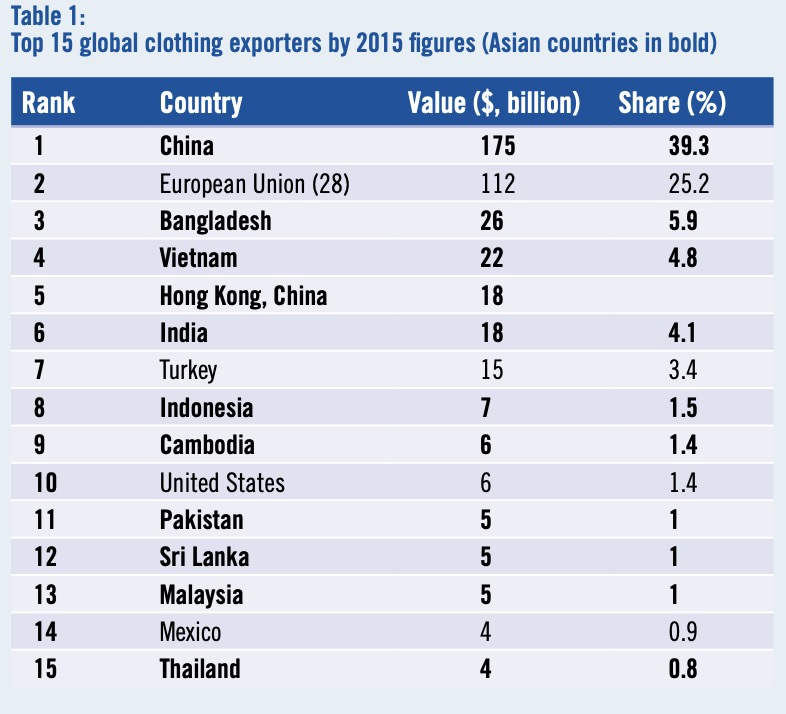
Country comparisons
Varying significance
Because of Asia countries’ own unique historical circumstances, garment production have different significance to each country’s economies.
For example,
Bangladesh’s 80% manufacturing exports are made up by garments.
Cambodia & Sri Lanka have clothing exports as 50% of their whole exports.
India’s garment industry takes the lowest proportion among these countries, which is only 5.5%
Here, Table 2 provides more elaborate data of each country’s dependence of garment industry. 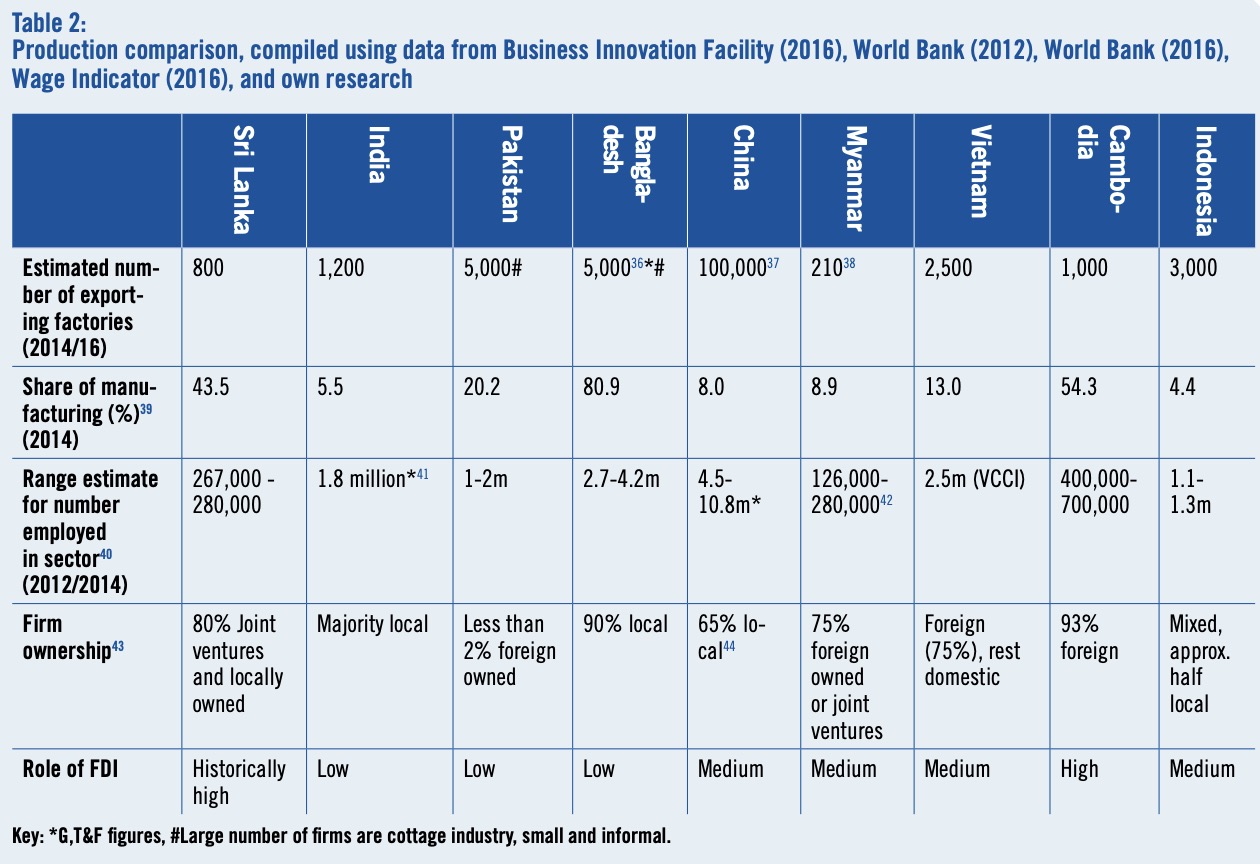
Product differentiation
Asia’s garment exporters can be split into two groups:
Low-cost basic commodity items: Bangladesh, India, Pakistan, Cambodia, Vietnam.
Higher value-added technical items: Sri Lanka, Myanmar, India, China.
Working conditions
Working conditions vary greatly across countries and companies. The long-standing key issues are low wages and insufficient occupational safety.
Excessive working hours: This is common in the clothing industry. In Cambodia, half of all garment sector employees worked more than the allowed 48 hours per week. In Pakistan and Vietnam, more than 40% work excessive hours.
Dangerous working environment: During 2007-2017, at least 1,500 people have died and 3,000 have been injured in fires or collapsed buildings in textile factories (J.Safra Sarasin in 2014).
The following picture is the collapse of a building that housed several clothing factories in Bangladesh. More than 1,100 people have died which is the worst disaster in garment industry history. 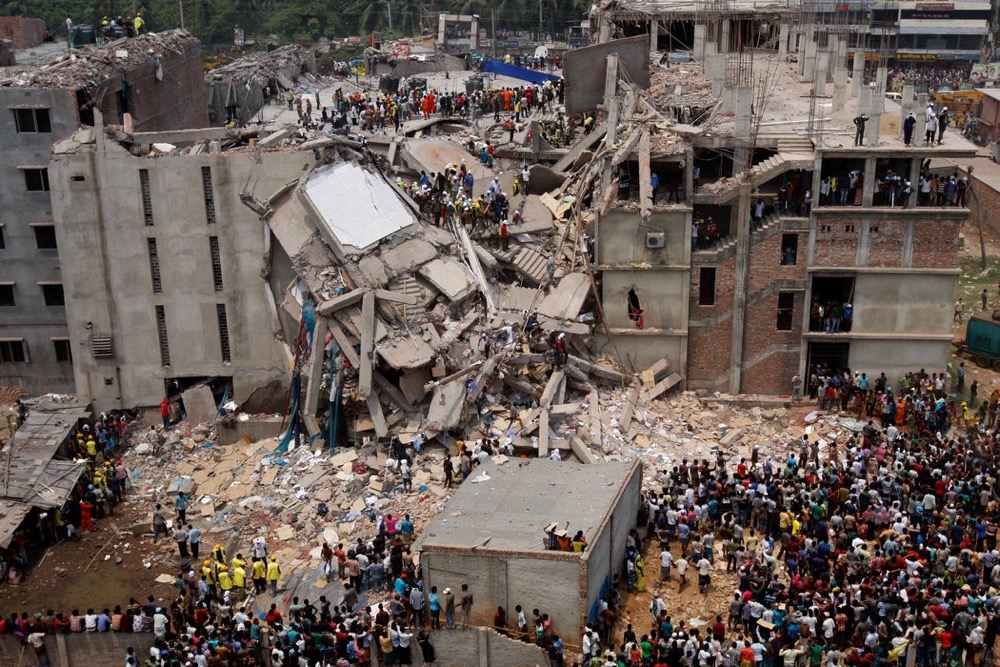
Gender issues
Wage disparity: Although there are differences in the ratio of female employment in garment industry across countries, women consistently lag behind men in terms of wage. From the table below, we can see that in most countries except for India and Pakistan, women comprise the vast majority of all clothing industry employees. 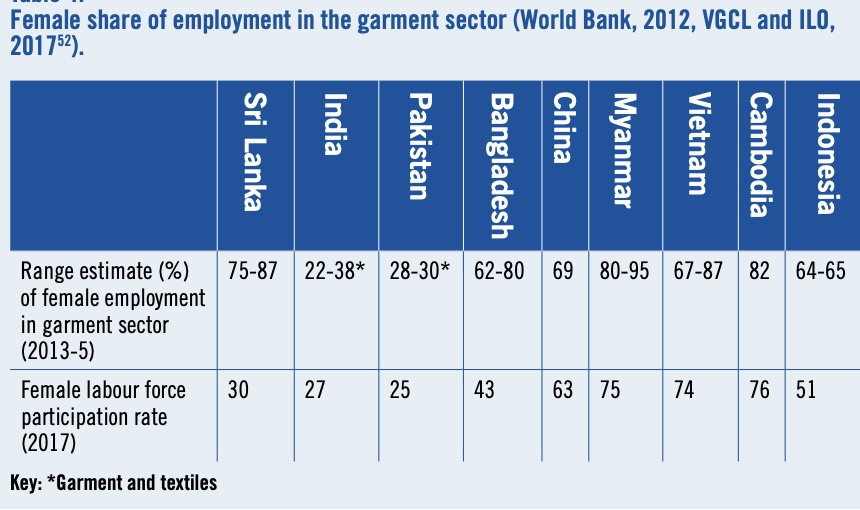
On average, female garment workers earn 11% less than male workers. The gap can be particularly huge in Pakistan and India which are 48% and 39%, respectively.
Job segregation: Female labour is concentrated in jobs such as weaving and sewing, but their male peers mainly work in more technical and skilled positions like machine supervisors.
Career progression: In this aspect, there is also a glass ceiling for women. For example, in Bangladesh, just over 1 of 20 supervisors was a woman. Also, the new technologies place women at greater risk of redundancy since the manual jobs are redundant.
Environmental Sustainability
Different stages of production actually have different environmental concerns. Among them, upstream suppliers have the greatest potential of polluting.
Textiles & Tanneries: Heavies use of polluting chemicals.
Cotton growing: The most water intensive processes such as dyeing/printing and finishing.
Clothing assembly-to-retail: Greenhouse gas emissions arise from transportation and packaging.
Last modified on 2023-10-16